Saturday, July 7, 2012

His Girl Friday - 1940


How can a film, without any steamy sex scenes and French kisses, manage to be very HOT & SEXY nonetheless?

His Girl Friday is not the first American Classic film I ventured into. It's Gone With the Wind, 1939. It is a beautiful film, very complex but it was a bit over the top with its costumes and dresses and drama. Therefore, it shaped my whole perspective towards what pre-1950 American Cinema was all about.

Then, I watched His Girl Friday and hell, I was swayed within seconds. The intelligent fast dialogue, the humour that makes me laugh my ass off and the crystal-clear chemistry between the leads that make me wanna say, "Damn to the both of you, just GET BACK together already!"

Walter and Hildy 


The plot is quite simple - a successful but difficult man, Walter Burns (Cary Grant), was a hardworking newspaper editor with a less-than-moral streak. He was superbly intelligent and kind when he wanted to but he could extremely manipulative if demanded [which was most of the time, really], especially when his ex-wife and reporter, Hildy, came to tell him that she's leaving the city to marry a new man, pursuing happiness at last after that tough miserable life she shared with Walter.


From left: the fiance, Walter & Hildy


Sweet words of romance was not one of Walter's many forte. He did not want her to leave but could not bring to say it out loud. But Hildy knew his disapproval of her decision. He tried everything - and managed to make her stay for a few more hours to report one last assignment about a murderer who claimed to be innocent. Along the way, Hildy was often reminded of her love for hard-hitting journalism and the addictive adrenaline that comes with it, especially while working together with Walter.

The script is really good, I must say. Despite the romance theme they had going on, the movie still managed to insert plots about an about-to-be-executed criminal who could be innocent, the dirty world of journalism and the politics above them which could be even dirtier. It is a smart film about smart people. And sometimes, smart people have feelings, too.

It was exciting to watch Walter and Hildy's interactions. Both of them knew all there was to know about each other - they were partners, best friends, enemies, former lovers, and all in all, equals. It was romance all the way. Who cared if all of that took place in a room above a prison complex? They were getting back together! Poor fiance, though. He was really a kind man. It was difficult, though, for him to fit in into the fast-paced world that Hildy belonged to.

How good is this movie exactly?

Well, it's good enough to make me want to watch all of Cary Grant's films. He was one sexy man!


Sunday, June 3, 2012

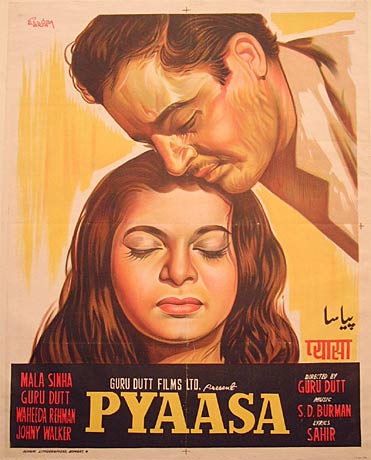
Pyaasa/ The Thirsty, 1957 - A Review

Directed and produced by Guru Dutt
Written by Abrar Alvi
Guru Dutt as Vijay
Waheeda Rehman.as Gulabo
Mala Sinha as Meena
Rehman as Mr Ghosh, the publisher 


Pyaasa or The Eternal Thirst. A simple cinematography with a complex storyline. Featuring - a poet who did not seem to know what he wanted in life but misery and the joy of the pain of living in it. But then again, he's a poet. What do you expect? A classic Guru Dutt films.


I love classical films. Partly because I dislike CGI or maybe, I am just an old soul in a young, albeit large, body. And I love India. And Bollywood films. And Pyaasa is one of its ultimate classics. Helmed by Guru Dutt, an icon in the industry, it featured many of Dutt's signatures - layered dialogues, unhappy love story, evil vs good, money vs poverty and the ultimate signatures of all, misery. Similar to Sahib Bibi Aur Ghulam, misery and the choice to live in it seemed to be the central focus of Pyaasa.


It revolved around a young failed poet by the name of Vijay, who, despite his college education, decided to leave his family and lived on the streets with the hope to successfully become a published poet. He, of course, failed. Poetry is easy to be produced but difficult to be sold. Poetry is art and its commercial value would be almost impossible to be measured. With nothing to live for but his art, Vijay mused alongside the city streets, spending nights on the bench and days roaming on the street of the city. He met his former girlfriend, now wife of a respected publisher who offered him a job as an assistant. He hated it but had no choice. He had no money to feed himself. Despite the resurfaced attraction to his former flame, Vijay was uninterested in rekindling their romance. He then met a prostitute, Gulabo with a kind heart who worshipped his poems. A friendship was formed. After struggling with rejections and failures, Vijay was mistakenly assumed to be dead. His poems was published posthumously with Gulabo's savings, only to become very popular, ironically after his assumed demise. He returned to his circles, only to be taken aback by the sudden fame and admiration by his newfound fans. It was too much for him to handle and Vijay finally chose to leave the city to start a new life with Gulabo.


Screencaps:-


What I love from Guru Dutt's films are the intensity of the characters' emotions. When they feel, they feel deeply despite the foolishness of it. In Pyaasa, we have Vijay, who was so against the human nature of pursuing wealth despite his stabile upbringing. He chose to be a poet whereas his college mates were leading successful lives. He was poor and homeless yet he was sincere, honest and passionate than turning into a pretentious materialistic businessmen like other characters in the film. His poverty was his choice to be free from the chain of capitalism.

The scene where he sang the song 'Jinhen Naaz Hai Hind Par' while roaming the red light district, seeing the drunken men chasing the sex workers had to be the most profound scene of film history of all time. It pinpointed many wrong things of human nature - lust, money, power, ignorance and selfishness. He kept questioning, where were the leaders when the poor had to sell themselves for food, where were the philanthropist, where were everyone else who cared.

)


The 'love story' part of the film was not of much focus here compared to Vijay's struggle against the world. There were two prominent female characters who were infatuated with him - the rich, respected but pretentious wife and the kind-hearted sincere prostitute. Both served as a contrast to exhibit the two different classes they lived in. Money was indirectly criticized here - wealth does not buy you honesty. Indeed, most of the well-off characters with money were depicted as ruthless, selfish and opportunistic ie the publishers, Vijay's brothers and his former girlfriend.

In the end, Vijay did not find happiness. But he had decided to leave the cruel world he was so miserably trapped in at last. He decided to leave and asked Gulabo, the kind prostitute to leave with him. Was it a happy ending? Not at all, in my opinion. It seemed that he gave up on the world, in search for a better one. But then again, what if there is no better world out there? What if the world that we are in right now - the capitalistic selfish world that it is - is the only one left? What would happen to Vijay, then? Would he give up and leave again? Would he kill himself out of dissapointment? I have no idea. He was brave to choose the way he wanted to live, I'd give him credit for that. But not everyone can afford to be like that. Someone has to stay and face the reality and work for things to change instead of complaining about it. Of course, that person is likely not a poet. And most likely not a sentimentalist. Or anything that's related to expressing emotions in any artistic manner.  

Watch the films if you enjoy anything that is melancholic, tragic, deep and poetic. It will leave you emotionally affected, its characters question your own and its songs - despite its obvious oldies origin - remain attached to your head.

And you will be laughed by your friends for watching a 1957 Hindi film despite living in the 20th century.

This film is even older than my country. Duh.